In 2015, Tracy Sandler started a fansite covering her beloved San Francisco 49ers. This led to her becoming a member of the 49ers’ press corps, where she reports live from the field and the locker room, attends press conferences, and covers community outreach events. After receiving an overwhelmingly positive response, she nationalized her site, creating the Fangirl Sports Network, a digital media company reporting on every professional team in the NFL and NBA, with special coverage of accomplished women making waves in the sports industry.
One thing I try to do every day is…
Get some type of workout in! For me, working out is as much about my mental health as my physical health. Whether it’s 20 minutes or an hour, that time is my time to release stress and take a little time for me. I recently got a Peloton bike which makes finding the time to work out a lot easier.
I improve myself…
Through self-reflection. In difficult situations, I reflect and see if I could have handled it differently, if I was justified or if my reaction was warranted. If I’m not sure, I have a couple of trusted advisors that will be honest with me.
I feel most alive when…
I am covering a game. I’ve worked really hard to get where I am, so when I’m at a game, covering the team I’ve been a fan of since I was a little girl, it really is the absolute coolest feeling. Second, when I’m with my nieces and nephews. I have two nieces and two nephews, and they are the lights of my life.
“In difficult situations, I reflect and see if I could have handled it differently.”
My favorite inspiring quote is…
49ers’ cornerback Richard Sherman said something this past season that really resonated with me. He said, “The best ability is dependability,” and he’s right. Talent and skill sets may set you apart, but showing up is such a big part of it.
To avoid distractions, I…
Put my phone on Airplane mode and focus on the task at hand.
I handle negativity by…
I try to follow The Four Agreements by Don Miguel Ruiz. As he says in the book, even things that seem really personal are not. They come from another person’s experiences, insecurities and negative feelings about themselves. As long as I’ve behaved and am living my life in a way that I am comfortable with, I am happy.
One thing that is difficult for me, but I enjoy is…
Giving back to the community. I say it’s difficult, because it is hard to hear the stories of and see firsthand those who have been mistreated or have not been given a fair chance in life through no fault of their own. I enjoy it, because I want to be able to give back and do my part to help those who need it.
I define success as…
Being content with where you are and what you are doing. Do you enjoy going to work? Are you trying to help others in the process? At the end of the day, do you feel accomplished? If the answers are yes, you are successful.
It’s 2007. Jay Shetty is 19, studying management science at Cass Business School in London. He’s a typical university student by standard measurements. He attends most classes, but skips on occasion. He plays soccer for fun. He hangs out with friends on the weekends. He likes to read about successful CEOs and entrepreneurs and fantasize about his own future: Graduate, work in corporate, get married, have kids and a nice home.
One night, his best friend invites him to hear a Hindu monk, Gauranga Das, speak on campus. Shetty isn’t interested. He’s attended those talks before, but only the ones given by those CEOs and entrepreneurs he reads about. A monk doesn’t have anything to offer him. Eventually, he’s convinced with a promise of going to the bars afterward. That night, Shetty would meet the person who would become his mentor and arguably one of the biggest influences for who and where he is today.
“I had met people who were rich,” Shetty says. “I had met people who were famous, but I don’t think I had ever met someone who was happy. The monk, to me, seemed happy and joyful. He looked like he had a meaningful life.”
Shetty is enamored. So much so that he begins following Gauranga Das around the U.K. to hear him speak. First, at university and corporate events; then to an ashram in India during summer and holiday breaks from school. He begins splitting his free time between corporate internships and the ashram. At school, he hosts weekly discussions, during which he shares what he’s learning from the monks and his studies. The more he learns from Gauranga Das and the other monks, the more empty and unfulfilling his corporate dreams start to seem. He feels a pull. This part-time life simply isn’t enough.
It’s 2010. A newly graduated Shetty is looking at job offers with promising career paths and enticing salary ranges. Without a second thought, he announces to family and friends that he’s off to live, learn and serve as a monk.
In a Hindu ashram just outside Mumbai, Shetty accepts orange robes to wear. He shaves his head and selects a thin yoga-mat-like pallet next to 12 or so others in a bare room with smooth, stone floors. This is now home.
The next three years are filled with service, living and traveling across the U.K., Europe and India to build sustainable communities, feed the homeless and teach meditation. For Shetty, there is no looking back.
“When I became a monk, it didn’t feel like I was giving up that much,” Shetty says. “I actually felt like I had made the best decision, because anyone who hadn’t focused on building themselves up was the one losing out.”
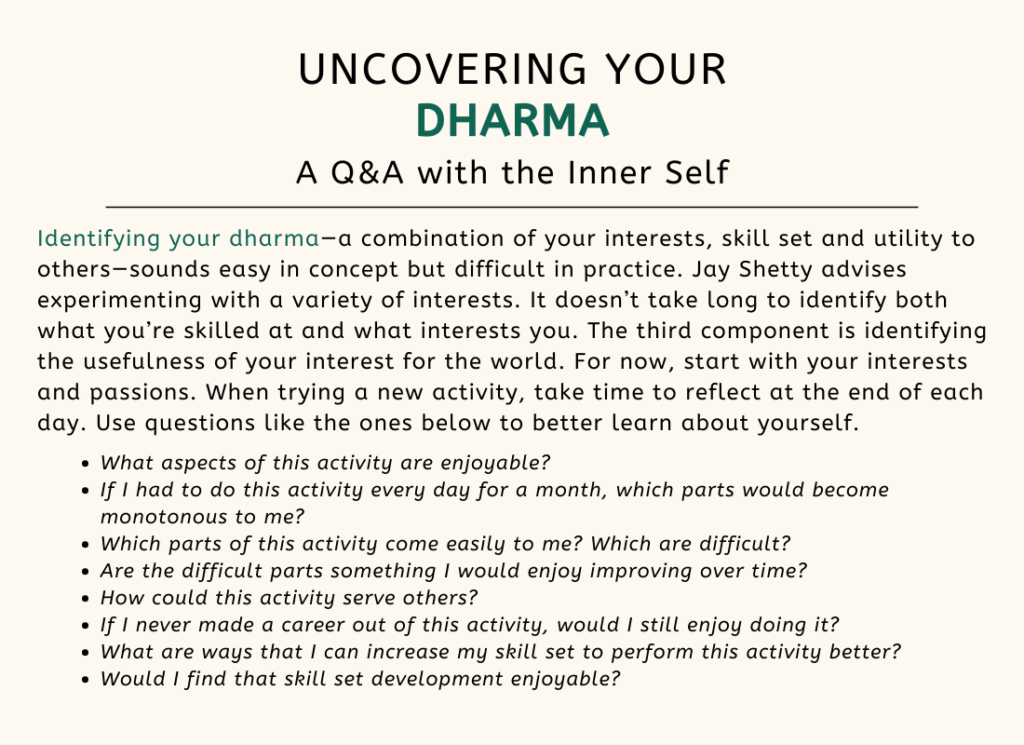
Dharma is a Sanskrit word. Like many other words in this language, it doesn’t have a perfect English translation. Loosely, dharma means “one’s calling.” Shetty defines it like this: Dharma is the intersection of passion, skills and usefulness.
The monk’s life of service is Shetty’s dharma. Or so he thinks.
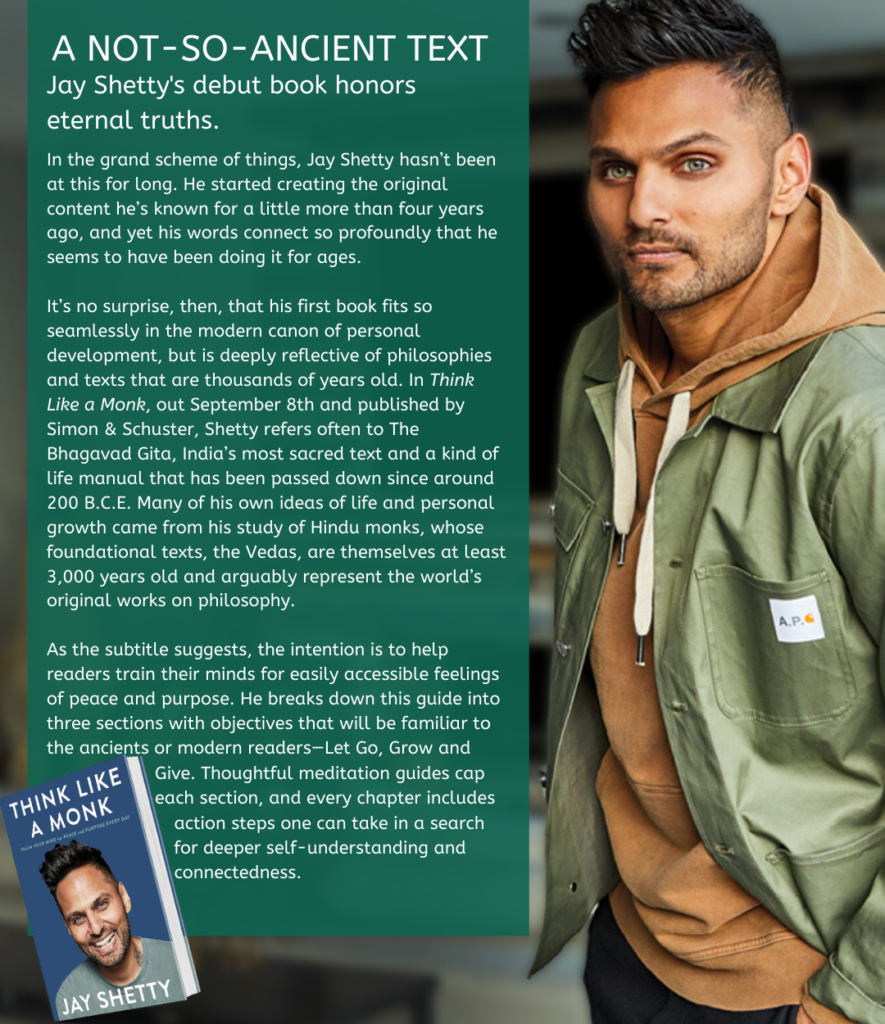
It’s 2020. A 32-year-old Shetty is known globally for his inspirational videos and podcasts. He’s a storyteller and author of the new book, Think Like a Monk. His social media accounts have 34 million fans, collectively. His videos have been viewed more than 6.5 billion times and the award-winning On Purpose is the No. 1 health podcast in the world. He’s been on The Today Show and Ellen. He’s interviewed inspirational powerhouses such as Dr. Mehmet Oz, supermodel Gisele Bundchen and late professional basketball player Kobe Bryant.
His goal is to bring ancient wisdom in a way that makes sense in modern times. He helps people create space for their purposes to reveal themselves, and then to pursue them relentlessly with the goal of building fulfilling and meaningful lives.
“How do we make wisdom relevant and accessible?” Shetty says. “How do we merge entertainment and education? We live in a world where entertainment wins, but if entertainment can have an educational heart, then we can really change people’s lives.”
How did he get here?
A Series of Goodbyes
In 2013, Shetty left the ashram and arrived on his parents’ doorstep with $25,000 in student loan debt, no money, no plan and an overwhelming sense of failure.
“I had built up this vision of who I was, who I want to be and where I want to go,” Shetty says. “All of a sudden it’s just crumbling away, and I don’t really have a good reason apart from the fact that something inside me was telling me that [the monk life] wasn’t right for me.”
He later learned that pain was caused by his attachment to the identity of being a monk. Attachments cause pain. A dog, a person, a childhood home—they all bear emotional significance. When we lose those things, whether it’s unplanned or expected, we feel grief, one of the most powerful emotions in the human experience. It drowns out our other emotions and hijacks our ability to think, look or move forward.
Eventually he realizes that, in the moment, he forgot his monk training. It’s relatable. We can all recall times of failure, in which the vision we had for our future lies in pieces at our feet. Of course, we can’t eliminate everything that bears emotional significance to us. That would be a lonely life. But we can separate ourselves from the feeling of loss through detachment.
Detachment, by the monk’s definition, is not about being indifferent, but about understanding that everything is temporary. That you don’t truly own anything. Thankfully, this means that nothing can own you, either, if you don’t let it. In a world consumed by attachments to objects and accolades, the monk method seems impossible. Shetty explains it to me simply.
A professional ice skater has trained for years to master her sport. She’s known as an athlete and she self-identifies as one. In fact, she doesn’t know another life than this one. A tragic injury steals the opportunity for her to continue skating. She’s young and full of promise, but can’t see a life beyond the ice.
This story has been told a thousand different ways with a thousand different endings. Some in this situation might fall into a depressive state, unable to cope. Others might understand that they were given a gift for a time, and that gift is now given to someone else for a time. Now it’s time to uncover what’s next in their journey. Maybe they become a skating coach and help others develop and grow in their purpose. Maybe they do something else entirely.
With this mindset of detachment, what was once seen as failure and disappointment can be redefined as simply the next step in life. To find your dharma—or more accurately, to allow your dharma to find you—is to deconstruct the facades of identity that we build. It requires a loving detachment from those things for which we once felt ownership.
For those without a gift for ice skating, the path doesn’t always present itself so clearly. This is a time of experimentation. It doesn’t matter whether you’re 15 or 55. You owe it to yourself to try new things. How will you know what you like or what you might be good at, and certainly what might be of service to others, if you don’t know what it feels like to do it every day? Try new things, and trust your instinct, Shetty says.
“It doesn’t take long to get a sense check. If you ate Mexican every day for a month, you would know whether you liked eating Mexican food. It’s not complicated.”
Start by shadowing people who are already living out the dharma you’re considering. The key here, Shetty says, is to shadow people in their early stages. If you want to become a serial entrepreneur, then shadowing Mark Zuckerberg around the small country that is Facebook headquarters isn’t going to be much help. You need to see the trials and risks that new entrepreneurs face.
“I think most people look at others and think, Oh, I want what they have,” Shetty says. “But then they don’t want to do what that person has done to get there. To me, true inspiration is that second part.”
It took Shetty time to understand that people don’t have a single dharma or purpose in life. No one is skilled and passionate and useful at just one thing. By releasing the pressure to be singularly focused for life, you allow yourself the freedom to explore and grow. And in that time, you allow your dharma to find you.
That pressure has real and damning effects. Children, pressured from parents, coaches and teachers, try to have it all figured out before the age of 18. They commit to a single sport before high school. They pad their college résumés with extracurriculars they don’t even enjoy. They plan a life that they couldn’t yet possibly understand.
The results: crippling injuries from the effects of single-sport training. Growing muscles weren’t intended to be singularly targeted for years on end. Burnout, anxiety and depression reported by younger generations in unheard-of numbers.
“I see my whole 20s as a massive experiment,” Shetty says. “So were my teens. I think the problem is that we’re not encouraged to experiment; we’re encouraged to decide and choose, be singular and focused. You can’t be that until you experiment. You don’t know what’s going to work until you try it.”
Redrawing the Roadmap
There were little hints of Shetty’s dharma sprinkled throughout his life. His parents wanted a secure career path for him, such as law or medicine. But in his teens, Shetty fought to focus his studies on the things that drew him in, such as philosophy and the arts. As his love of philosophy grew, he had a desire to share the wisdom he was learning from Gauranga Das. His extracurricular club, Think Out Loud, became popular at university, but on the night of his first talk, not one person showed up. Channeling his lessons from summers spent at the ashram, he thought, What can I learn from this? And then Shetty proceeded to deliver his talk to an empty room.
Monks believe that everyone is both a teacher and a student. The hierarchy in a monastery is circular. Senior monks teach classes, but may also attend a class taught by a 10-year-old monk in training. Shetty learned quickly that preparing for and teaching classes was one of his favorite activities. He spent hours researching ways to present ancient lessons in modern ways. After all, he and many of the other monks weren’t raised as monks. They all had pasts that included secular schools, girlfriends and video games. He was excited by the challenge to meld those two worlds.
Of course, life outside the ashram doesn’t grant the luxury of an unearned audience and hours of unpaid research time. So Shetty began applying to jobs. Surprisingly, three years as a monk planting potatoes, cleaning bathrooms and meditating for hours on end doesn’t land well on a résumé. Dozens of applications were rejected.
“Becoming a monk was a hard decision,” Shetty says. “Leaving being a monk was harder, but it’s given me so much faith in my ability to transition, and that what I learned as a monk can still serve me.”
He persisted, learning how to market those skills in the modern world. Finally, he landed a job at a consulting firm. The job didn’t particularly interest him, but it paid the bills. He remembers looking at spreadsheets and thinking ruefully about what he left behind. He didn’t have time to spend a day in a library researching ancient philosophy. He had to meditate in the fringes of his schedule. One night, while washing dishes in his parents’ home, he imagined what he might be doing at that exact moment back at the ashram. It was 7 p.m. He would be studying, researching or teaching.
I still have that choice now, Shetty thought to himself. “No one has taken that choice from me to live out this process more. It’s up to me whether I want to keep this process alive in my life.”
Shetty sold the idea of a weekly office mindfulness meditation session to his supervisor. It grew, transforming into motivational talks offered at company events. Eventually, Shetty began traveling around the country, speaking at corporate events on spiritual and mindfulness topics at behemoth brands like Coca-Cola and Facebook.
“This was a global consulting firm,” Shetty says. “This wasn’t a mindfulness company. This wasn’t a meditation company. Every interest can be used in your current life with a little creativity.”
Like Shetty, most people don’t have the savings account to quit their secure job to pursue their purpose with abandon. A less dramatic approach, then, is to pursue your interests and skills within your current lifestyle. Many already do this with side hustles. If you’re an accountant with a mean set of baking skills, try hosting a weekly baking challenge at your house or start offering to bake treats for work events. By reducing the risk and pressure that a full-time venture would require, you allow yourself the freedom to scratch the idea at any given moment once it’s no longer serving you.
The Never-Ending Story
A few months before Shetty left the ashram, he fell ill. A monk’s life of service isn’t easy. His body was exhausted and malnourished. He spent two months recovering. Doubt had been creeping into his consciousness for awhile, but with nothing but his mind as company, they grew. He loved teaching. He loved sharing the wisdom that he gained. He loved the idea of making it relevant for the modern world. But it was a dream that didn’t fit into the framework of a monk’s life.
One of his spiritual teachers, Radhanath Swami, came to visit him. Shetty shared his doubts with the senior monk. Radhanath Swami reflected for a moment and replied, “You’ve done your training. I think it’s best if you move on now.” Gauranga Das agreed.
Shetty was stunned. It felt like the worst breakup he could imagine. But it ultimately led him to a deeper understanding of his dharma.
“My three years as a monk were like the school of life,” Shetty writes in Think Like a Monk. “But applying wisdom outside the ashram—the hardest part—felt like the final exam.”
On Jan. 3, 2016, Shetty released his first video on Facebook. He enjoyed making it. He was proud of the finished product. And people responded positively. He kept creating. For the next seven months, he spent his free time—after a long day at the office and in place of weekend plans with friends—creating content he believed in. His audience grew quickly enough that in August 2016, Arianna Huffington reached out with a job offer. Things accelerated from there.
But none of it would have been possible had he stayed at the ashram and pushed down the doubts in his mind. No one has a singular dharma, and that dharma can change over time.Where it fits in your world will change and continue changing over the course of your life.
“I’ve been doing the same thing now for 14 years,” Shetty says. “And for the first 10 years, I had zero followers, made zero money from it—there were no results, in a sense. But those 10 years gave me the ability to develop a skill set that was dedicated to growth and learning needed to turn this into something real.”
Shetty was once a monk. Then he was a corporate employee. Then he was a storyteller and host of On Purpose podcast. Then he was a content creator. Then he was an author. His dharma is to reach every single person on the planet. If it seems impossible, well, that’s the point.
The pursuit of one’s dharma—that intersection of passion, skills and usefulness—isn’t an end goal, but a lifelong saga. It’s an endless series of digging deeper into your purpose, detaching from previously held identities and moving the goalpost after each accomplishment.
“Realizing that the ultimate goal is unattainable is what keeps us humble,” Shetty says.
* * *
In a world that promotes tunnel vision and black-and-white focus, to experiment and reject singular identities is a radical move. It’s also a necessary one. Positivite psychologists conducting studies have proven monks to be the world’s happiest people. Their brains are healthier at older ages than those of the general population. Logically, if you’re looking to become happier (who isn’t?), then you would seek guidance from the 1 percent of the population who exude happiness and contentment, just as you would seek out a world-class athlete for tips on resilience and mastery or a Fortune 100 CEO for suggestions on leadership and vision.
This is Shetty’s offering to the world. His ideas are inspired by timeless wisdom that he’s making relevant and accessible. Shetty learned them from the ancient texts and lessons that have been passed down for generations. But he offers an intimate look at a life of self-awareness, focus, flexibility, drive and humble acceptance.
The way of a monk allows you to pursue interests without worrying about taking them to the end goal. To understand that your weakness isn’t weakness, it’s just someone else’s dharma. There is no competition because we’re each on our own journey.
“[Understanding dharma] frees you from this pain of, I’m competing with everyone,” Shetty says. “It frees you from this attachment that if they make it, then I’m not going to make it.”
Shetty has no way of knowing how his work could affect the lives of future generations. But it’s not about him, it’s about pursuing his dharma in the service of others. This is the monk’s highest calling. He remembers Gauranga Das’ words from when they first met: “Plant trees under whose shade you do not plan to sit.”
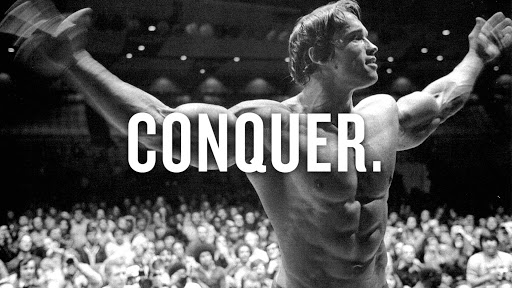
Arnold Schwarzenegger was born on July 30, 1947, near Graz, Austria. He rose to fame as the world’s top bodybuilder, launching a career that would make him a giant Hollywood star via films like Conan the Barbarian, The Terminator and Total Recall.
After years of blockbuster movie roles, Schwarzenegger went into politics, becoming governor of California in 2003. He returned to the big screen after leaving office in 2011, finding success with The Expendables franchise and a return to the Terminator series.
“If you have plan B then you dont trust plan A” – Arnold Schwarzenegger
In life planning is important , we usually believe that plan an optional plan b is important but Arnold clears this myth …… watch this video
Joel Brown is the founder of Addicted 2 Success, a site he created with the intention for it to be the #1 motivation site in the world. Joel’s passion is to transform lives with the blog, podcast, and social media. Joel has reached well over 143 million viewers since he got started. His Instagram is updated every day with motivational quotes, videos, and highlights of other high-level entrepreneurs that are bound to help you keep up your momentum and crush it!
“Do you remember how it felt when you left your 9-5 job? I do. 7 years ago I told my boss to kick rocks. What a feeling!
There is an opportunity for you right now in the online space to build a career with a freedom lifestyle. If you are inspired to go full time with your coaching, speaking or inspirational brand then DM me the word “freedom” and we can have a chat.
No more excuses. Life is short and there is no point spending most of it living someone else’s dream.”
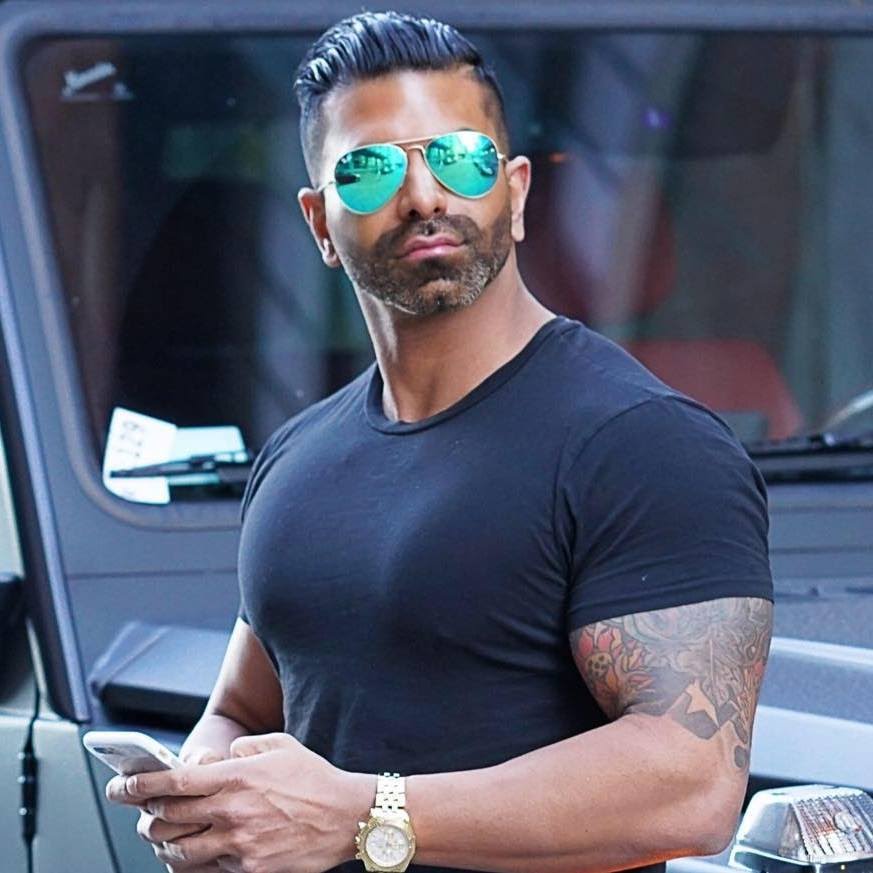
Arvin Lal is an Indian-American Businessman. He was born on March 21, 1985, in Queens, NY. He is the CEO and founder of Shredz and Beyond Genetics Supplements.
Arvin also participated in the famous American reality TV series Jersey Shore as a cast member which was aired on MTV.
Arvin tells us how to prevent ourselfs from losing focus from our goals , how to isolate ourselfs and work harder.
Watch this video
If you like this post like it and follow for more motivational blogs.
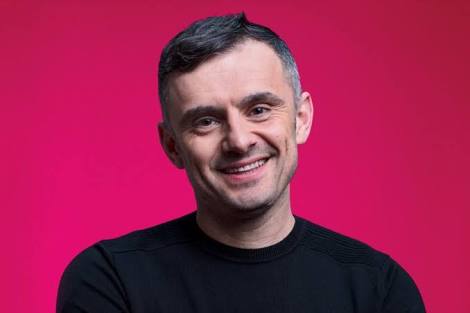
Gary Vaynerchuk is the chairman ofVaynerX, a modern-day media and communications holding company, and the active CEO ofVaynerMedia, a full-service advertising agency servicing Fortune 100 clients across the company.
Watch this video where gary speaks how judgement in life is very important
How this man sold his house for doing buisness, living with inlaws and more..











 Getmotivated